
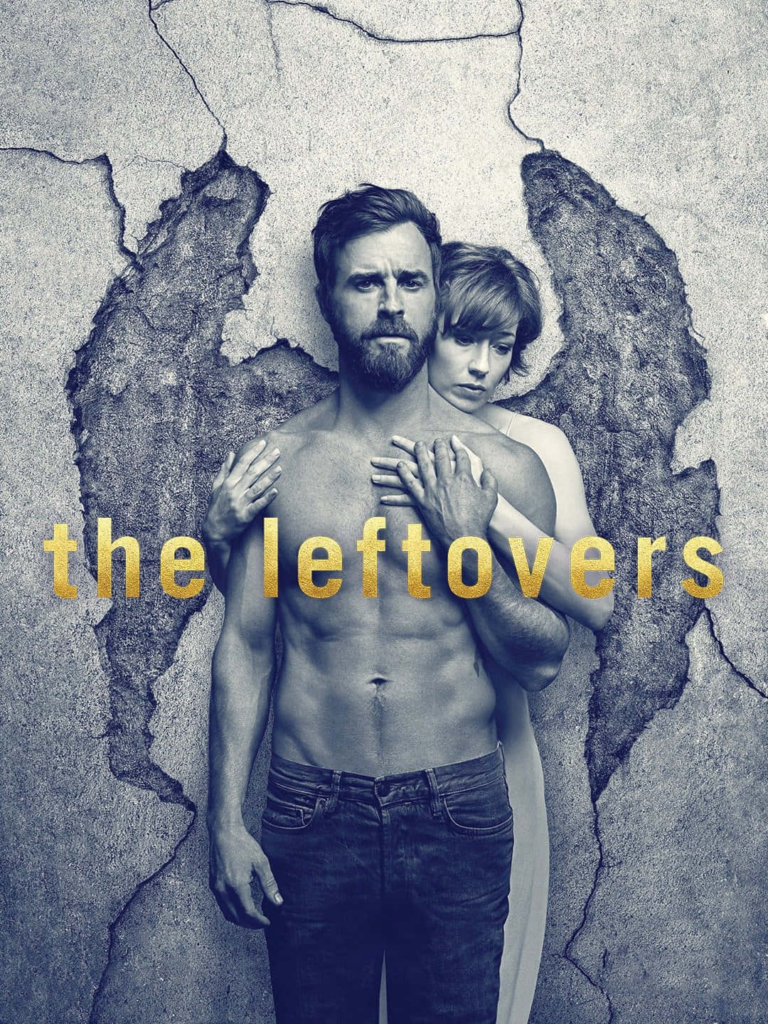
I just read that this was the most perfect series ever, lasting just 3 seasons for very good reasons. I’m not sure I would agree.
The book was published in 2011 and the series aired 2014 – 2017.
When I read it then and watched it then, I thought it was terrific, and I remember that the ending “blew me away,” to use a hackneyed phrase.
But re-watching it, I was overwhelmed with the tedium of having to listen to what is, essentially, a show where everyone is neurotic or just damn crazy. Everyone has joined a cult, or is following a cult-type leader, or is trying to justify and “prove” his or her religion. And because we’re constantly listening to crazy people, it’s not really possible to accept anything anyone says at face value. They are all unreliable narrators.
This is less true of the novel, to its credit. And the novel matches, somewhat, only in the first season: sort of like The Handmaid’s Tale. The following 2 seasons are additions to novel, but they are, essentially, repeats of the first season with slight variations.
Most of Tom Perrotta’s characters are sane people surrounded by neurotic people or impossible situations. What I like about his books, and what I liked about this one, is how these people, who are not quite Everyman or Everywoman in that they are usually smart, navigate a kind of “lesser” world — and illogical and fairly stupid world.
In the series, Kevin, the main character, is unfortunately suffering from some sort of repeated fugue state and may actually be following in his father’s footsteps. His father lost his mind and was committed. As a result, there is really no one to grasp onto — no one who you really want to get behind. Nora, the eventual love interest, is the closest to normal in the series: but even she shows herself to be unreliable and possibly crazy.
Not that they shouldn’t be or that if something like this happened — where 2% of the world simply disappears in front of everyone’s eyes — the world wouldn’t go nuts trying to find a religious or magical answer, simply because there is no science that can explain it.
But by the end, there were too many unexplained behaviors: why did the Nora character return but never told Kevin, the man she loved, that she was back? Why did Kevin pretend not to know their entire history? Why was Kevin not angry?’
And my pet peeve about any work, but especially movies, is why so much animal abuse? I know animals aren’t hurt on sets, because of the ASPCA, but it still bothers me when writers kill animals, either for some symbolic purpose or just for laughs. It bothers me when they use them at all. The last “Hangover” movie was so filled with animal abuse for laughs, I didn’t even bother to watch it. The second “Hangover” movie featured a smoking monkey. The first Hangover movie featured a caged tiger that was “stolen” from Mike Tyson and which they found in their bathroom. It also showed a chicken that was moving about the room. I don’t know why writers think that accidentally killing an animal is funny. I just don’t like to watch them. And this series was no better than the horrible Hangover movies: in the first season, he and some man who might not be real, are hunting dogs. There are deer that have some symbolic meaning. He hits a deer with his car and then kills it. In the second season, a goat is killed every day as part of some ritual that everyone accepts and in the third season, it’s a lion.
I know that closely observing animals and animal behavior can provide very helpful illuminations and even guidance into our own behavior: especially with the young and vulnerable. Jane Goodall, for example, said that watching the gorilla Flo as a mother taught her how to be patient with her own child. I myself have marveled at giraffe behavior which can seem so peculiar to others (if they notice it at all.) Giraffe have this strange sort of “presence” with each other, in that they will generally roam and graze in a group of 4 or 5, but then it’s not unusual or any surprise for one of the group to simply wander elsewhere and split off from its “group” and graze alone. It’s only during the female estrus that the males will actually engage and start bashing their next against each other, until one pushes the other off and he has won the right to mate. Other than motherhood, giraffe don’t seem to have much need for relationships with others.
While a pride of female lions always stays together and helps raise the youngsters (It Takes a Village). Or a pack of wild dogs have extraordinarily tight bonds.
These things can help us understand our own needs for relationships, or not. But hurting animals in movies: I just don’t get it and I don’t like it.
But for me, the real flaw of the series is the constant screaming about God and religion and faith and blah blah blah. I can’t stand to even listen to people talk about God or Jesus or any of it, because THEY HAVE NO PROOF. What they are essentially always, endlessly arguing about, are the words and instructions of an invisible being who has given us no evidence that he exists. And that I find exhausting.